Holy Week is one of the most intense periods on the Spanish religious calendar. For a week, cities across the country stop, the streets get full with processions, and the daily routine changes completely. For those visiting from abroad, it can be one of the most striking cultural experiences. For those who already live here, it is a week with its own distinct character that arrives every year with the same force.
The celebration has deep religious roots. It marks the final days of Jesus Christ's life, from his entry into Jerusalem on Palm Sunday to his resurrection on Easter Sunday. In Spain, they don't even celebrate Easter itself as much as the entire Holy Week, which is how Spaniards refer to this period. But even for those with no connection to the Catholic faith, it is a cultural and visual event of great impact.
Holy Week begins on Palm Sunday and ends on Easter Sunday, lasting a total of eight days. During this period, the brotherhoods (cofradías), which are religious associations with centuries of history, organise processions through the city streets. Each has its own religious statues, costumes, and route. In cities like Seville, dozens of brotherhoods parade throughout the entire week.
What happens during the processions
The pace is slow, deliberately slow, and the atmosphere is solemn. Anyone expecting a lively party will instead find silence, marching music, the smell of incense, and a rhythm that can last for hours.
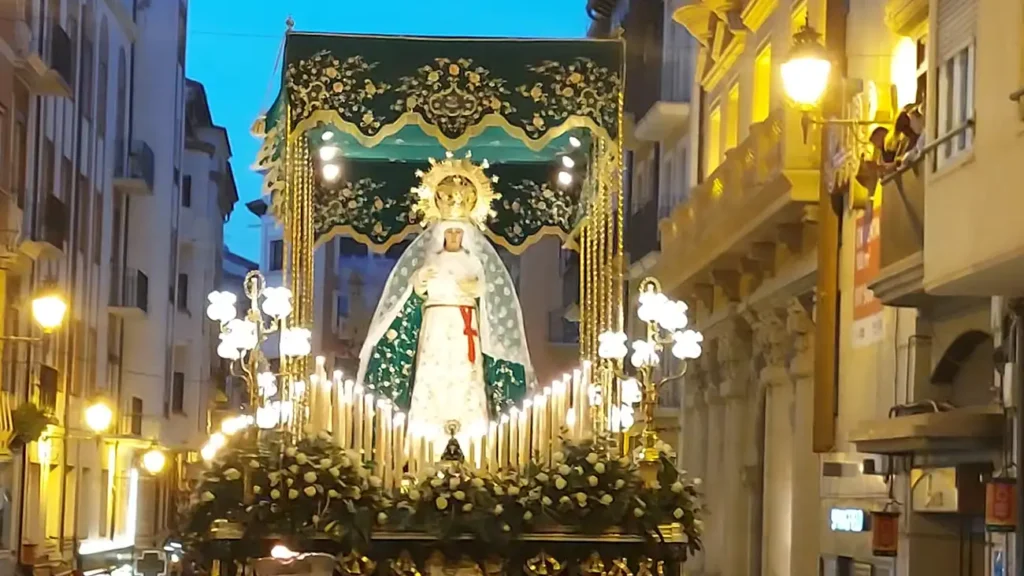
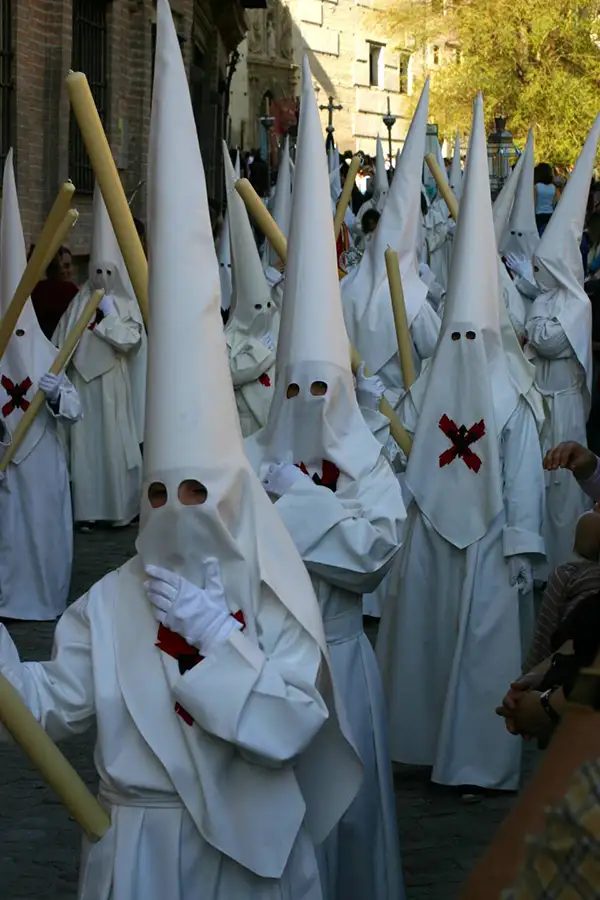
The procession is made up of nazarenos, members of the brotherhood dressed in tunics and hoods, who walk in single file carrying candles. Behind them come the pasos, enormous structures with religious statues carried on the shoulders of dozens of people at the same time. The weight can reach several tonnes, and the bearers work in synchrony without seeing where they are going.
The music that accompanies the processions are the marchas procesionales (processional marches), a genre specific to Holy Week played by brass and percussion bands. The rhythm is slow and solemn, designed to match the pace of the procession. In some processions, there are moments of absolute silence that contrast with the roar of the drums. In certain cities, like Seville, it is also common to hear saetas, improvised flamenco chants sung from balconies as the pasos move down the street.
The hoods that look scary but aren't
Anyone seeing a Holy Week procession for the first time without knowing what it is, might be startled by the nazarenos. The pointed hoods covering the entire face, called capirotes, have an appearance that many associate with that American three-letter K organisation. But the history is completely different: the use of these hoods in Spain predates the American ones by centuries.
The origin dates back to the Middle Ages, when penitents covered their faces as a sign of humility, so that no one would recognise who was doing public penance. American supremacist groups adopted a similar aesthetic in the 19th century, but with absolutely no connection to the Spanish tradition.
Where to see Holy Week in Spain
Holy Week takes place in practically every municipality in the country, but some cities stand out for the size, tradition, and artistic value of their processions.
Seville
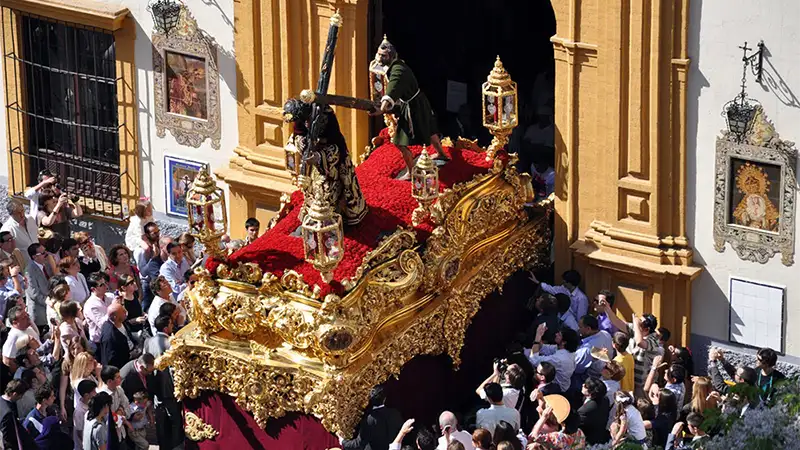
Seville is the most important reference point for Holy Week in Spain. Dozens of brotherhoods walk through the historic centre all week long. The amount of candle wax spilled on the streets is so massive that there are signs warning of slippery ground.
Málaga
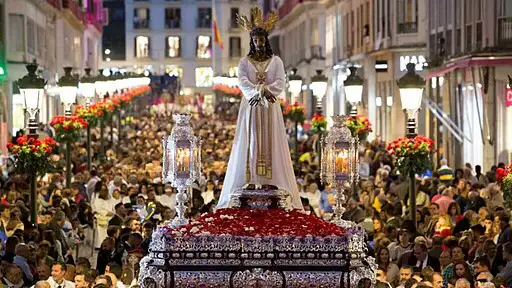
Málaga stands out for the enormous structures carried on the shoulders of hundreds of devotees, some of the largest in the country. The most striking moment is the parade of the Spanish Legion, which sings military anthems on Holy Thursday.
Valladolid
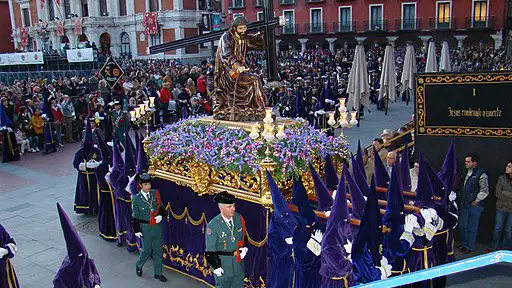
Valladolid takes an open-air museum to the streets. The sculptures featured in the processions are loaned by the city's National Sculpture Museum, including works by Gregorio Fernández and Juan de Juni, considered among the most important in European polychrome sculpture.
Zamora
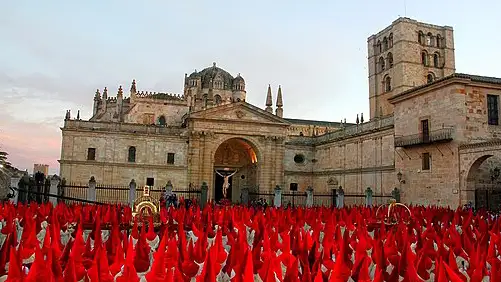
Zamora has one of the oldest Holy Weeks in the country, with records dating back to 1273. The most interesting aspect is the contrast between the absolute silence of the night processions and the music of the daytime ones. The Oath of Silence (Juramento del Silencio), on the night of Holy Wednesday, is one of the most striking moments.
Cuenca
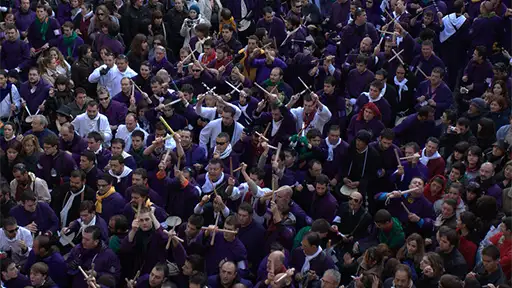
Cuenca has two events of International Tourist Interest in the same week: Holy Week and the Religious Music Week. The most famous moment is the Las Turbas procession, in the early hours of Good Friday, where a group of participants with uncovered faces run through the narrow streets of the old town playing drums and bugles chaotically, representing the crowds that mocked Jesus on the way to Calvary.
Zaragoza
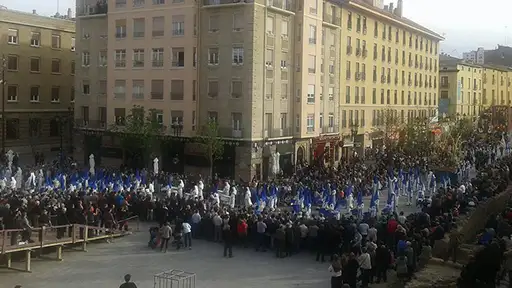
Zaragoza has over 700 years of history, 53 processions, and more than 16,000 brotherhood members. What sets it apart is the sound, with over 4,000 instruments (including drums, bass drums, timpani, bugles, and wooden rattles) accompanying the processions throughout the city. The highlight is the Holy Burial Procession (Santo Entierro) on Good Friday, where all the city's brotherhoods parade together in a single procession.
Holy Week is not limited to these cities. In practically any pueblo (village) or city where you happen to be during this week, you will find a procession. Hellín, in Albacete, hosts a tamborada where over 20,000 people play drums for days on end. Lorca, in Murcia, is famous for its biblical parades featuring horses and Roman chariots. Cáceres winds through its medieval historic centre lit only by torches. San Vicente de la Sonsierra, in La Rioja, keeps alive the only penitential flagellation ritual that has survived in Spain. The list is endless.
Is it worth seeing Holy Week in Spain?
Holy Week is one of those experiences that is hard to understand without seeing it in person. The slow pace, the silence, the music, and the atmosphere of the transformed streets are part of something that has existed for centuries and that Spain takes very seriously.
A practical detail for visitors: during the processions, the routes are blocked off to pedestrians, and if you are on the wrong side of the street, you won't be able to cross. In cities with many simultaneous processions, such as Madrid, you can easily get stuck for quite a while without being able to reach your destination. It is worth checking the routes in advance if you have bookings or transport to catch.