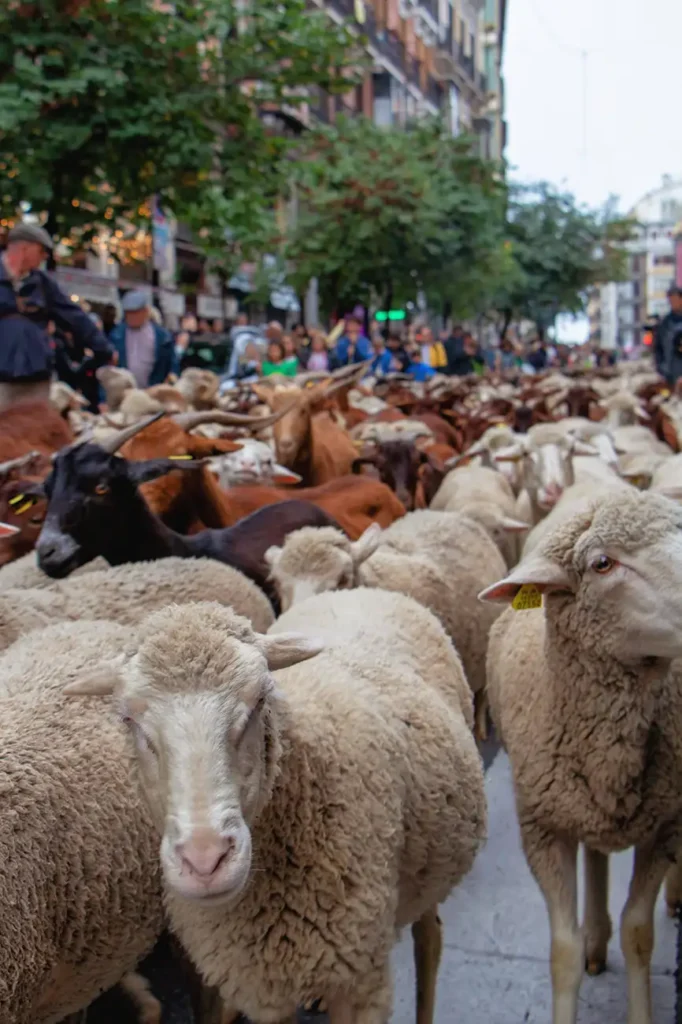
Imagine the traffic in one of Europe's major capitals coming to a complete standstill on a Sunday morning. Instead of cars and horns, the sound dominating the tarmac is the clanging of bells and the bleating of thousands of sheep. This scene, which takes place once a year in the heart of Madrid, is no random event. It's the Fiesta de la Trashumancia, a celebration that honours and upholds one of Spain's most ancient rural traditions.
What is transhumance?
Transhumance is the seasonal migration of livestock, a journey shepherds have undertaken for centuries in search of better pastures, fleeing the extreme cold of the northern mountains in winter and the searing heat of the southern plains in summer. The event in Madrid serves to raise awareness of this practice and to reaffirm the shepherds' right of way along the Cañadas Reales, the migration routes that, in many cases, existed long before the city expanded and paved over these ancient paths.
What you see on the streets of Madrid, therefore, is the symbolic union of the countryside and the city, a unique opportunity to witness a living piece of Spanish history and culture.
Date, time and route for watching the sheep in Madrid
The Fiesta de la Trashumancia follows a traditional schedule, but it's important to know that the exact date can vary each year. Even so, the event's regular pattern makes it easy to plan for if you wish to see it.
Date and time
The event always takes place on a Sunday morning during the second half of October. The main procession through the city centre usually begins around 10:30 AM, but the animals start moving much earlier. It is always recommended to confirm the exact date on Madrid's official tourism portals as October approaches.
The main route

The symbolic journey recreates the flocks' passage along a stretch of the ancient Cañada Real Leonesa Oriental. Although the full route is long, the main highlights for the public are concentrated in the heart of Madrid. The key spots where you can see the sheep are:
- Casa de Campo: The starting point, where the flocks rest before entering the city.
- Cuesta de la Vega and Calle Mayor: The animals' entry into Madrid's historic centre.
- Puerta del Sol: The passage through one of Spain's most famous and busiest squares.
- Calle de Alcalá and Plaza de Cibeles: This is the most photographed spot, where the shepherds stop in front of the Ayuntamiento (City Hall) to symbolically pay the 'maravedís' for their right of way.
- Paseo del Prado: The final stretch of the procession in the central area, before the flocks continue their journey southwards.
The Cañadas Reales: sheep routes older than the city ttself
The right for sheep to cross Madrid comes from the Cañadas Reales, an ancient network of livestock migration routes. Think of them as Spain's original motorways, designed for animals and protected by law since 1273, when King Alfonso X formalised their use to secure the vital wool economy.
This network of over 125,000 kilometres crosses the entire peninsula, and the most fascinating part is that many of these routes are older than the cities they pass through. As Madrid expanded, it grew over and around them. Major avenues today, such as parts of Calle de Alcalá, follow the exact path of an ancient cañada.
So, when the shepherds guide their flocks through the city, they aren't just taking part in a parade. They are exercising a historic right, walking on a layer of history that still lives on beneath the metropolis's tarmac.
So, why do the flocks migrate?
The answer lies in Spain's climate and the constant search for food.
In summer, the southern plains of the country (like those in Extremadura and Andalusia) become too hot and dry, and the pastures disappear. The flocks are therefore led north to the cooler mountains (such as the Picos de Europa), where they find lush, green pastures.
As winter approaches, the reverse happens. Snow and intense cold cover the northern mountains, making life there impossible. The shepherds then guide their sheep back south, where the climate is milder and the pastures grow back with the autumn and winter rains.
This round trip is the essence of transhumance: an ancient survival strategy to ensure the animals have food all year round. The event in Madrid, therefore, celebrates this practice and reaffirms the shepherds' right of way along the Cañadas Reales, the migration routes that connect these two extremes of Spain.
Practical tips for enjoying the fiesta de la trashumancia
Watching the Fiesta de la Trashumancia is a memorable experience, but being prepared makes all the difference in enjoying it to the fullest. Here are a few tips based on the experience of those who have been before.
Arrive early. To secure a spot in the front row, get there about an hour before the flock is due to pass and stand your ground. The reward is seeing and hearing everything up close... and yes, the sheep pass by so closely it's possible to touch them (but always with respect for the animals and shepherds).
Choose a strategic spot (and avoid the obvious). The Plaza de Cibeles is the most iconic spot, but it is also the most crowded. Minutes before the flock arrives, the police organise the crowd, creating a corridor. You might be lucky enough to end up at the front, or you could be pushed to the back. For a calmer experience with more space, consider spots earlier on the route, such as the Cuesta de la Vega (near the Almudena Cathedral) or along the Calle Mayor.
Go by Metro. Forget about cars, buses, or taxis. Several central streets are closed for the event, and surface public transport is diverted. The Metro is the most reliable way to get there. The stations of Ópera, Sol, and Banco de España are the best options for accessing different points along the route.
Look beyond the sheep. The transhumance is a complete spectacle. Don't just focus on the animals. Watch the shepherds in their traditional dress, the imposing Mastiff dogs that protect the flock, the donkeys that carry their supplies, and the musicians who often accompany the procession with flutes and drums. They are the soul of the festival.
Wear layers and comfortable shoes. Autumn in Madrid can have changeable weather. The Sunday morning is often cold, but the sun can come out and warm things up. Dress in layers to adapt. And, of course, comfortable shoes are essential as you'll be standing for a long time.
Be patient and enjoy the atmosphere. Remember that this is not a military parade with a fixed schedule. It is a real flock with its own rhythm. There might be delays or unexpected stops. Relax, enjoy the wait, chat with the people around you, and get into the festive spirit of the event.
The ecological role behind the tradition
The symbolic passage of the sheep through Madrid also serves as a reminder of the fundamental ecological role of transhumance. This ancient practice is a powerful tool for environmental conservation, with direct and highly relevant benefits today.
The moving flocks function as true gardeners of the landscape. As they graze, they clear fields and woods of excess dry undergrowth, the main fuel for summer wildfires. At the same time, they transport seeds caught in their wool over long distances, which helps to connect ecosystems and increase plant diversity.
The animals' manure also fertilises the soil naturally, maintaining the health of the land. Transhumance is therefore revealed as an intelligent and sustainable form of livestock farming, which has for centuries contributed to maintaining the balance of Spanish landscapes.